Phyllis raised an issue about her motor not working with her Brother knitting machine and had brought in her mast with the attached wires to see if members could help to solve it. Sandra suggested from previous experience that it could be the wires or part of one on the mast not set in correct position and therefore creating a break in the current and causing it to not work.
Sue showed some scarfs she had knitted from odds and ends of fine crepe yarn and had knitted them in various combinations of single and two colour tuck stitch and 1x1 card and just two different strands together in tuck. Each had been steamed to create floaty summer fabrics.


A previous member of the club had recently published a book about making jewellery, Gillian had brought it in for us to see.
Gillian also told the group how she had unearthed an old knitting diary from the early 1980's and had literally whizzed up garments in super quick time and then sold them for a pittance. A couple of sweaters with intarsia designs on the front for her two then young sons had been achieved over 2 days. Two cardigans including yarn had been priced at £5 for the pair.
All the gossip and news was then brought to a close and the main part of the evening started. Accessories and tools, the topic for this months meeting kicked off and there was so much to see.
Annette brought in her 7 prong tool. She uses it to do raglan shaping transfers. One tip is to not pull out the prongs to their fullest extent but only pull out a short way. She also brought a unicorn tool which is pointed and curved at one end and ideal for picking up dropped stitches. An old credit card with a v cut out was good for closing latches and moving needles.


Phyllis talked about her long handled tool with a magnet at the end for picking up dropped pins. She had found a great use for a dental mirror to see more clearly the needle hole to thread when sewing.
Vee brought in a swatch board with a sandpaper area to hold a swatch for measuring a tensions square. She had got an engineering friend to make a weighted cone spindle that kept wound off small cones of yarn in place and stopped them from falling over.


Valerie showed us her mid gauge garter bar and a shadow transfer lace tool which is used to move stitches from ribber to main bed.


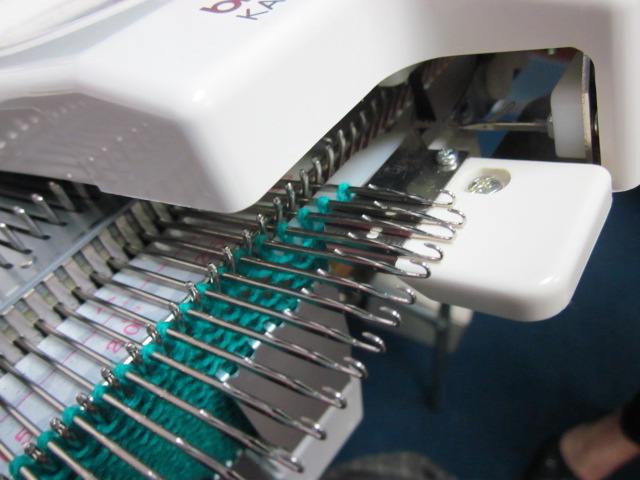
Sandra and Marcia had both brought in a Brother linker tool for casting off. This was later demonstrated on the machine. Another idea they had was a straw to thread fine yarn like crepe through before it going in the yarn mast to stop it twisting back on itself and causing tangles, when knitting multiple threads together.

Sandra brought in a homemade sandpaper board to explain how one can be made quite easily. A course paper is best and large enough for a good size tension piece and it is then glued to a piece of wooden board, plywood would be ok as its not steamed on the tension board, the idea is the sandpaper catches it gently enough to hold it flat for measuring. She also talked about her stand for a pattern that fits into the knitting machine case handles. She also had a wool winder, rib transfer tool, rib transfer carriage and knitting manuals all of which we all need more than you might think. A knitting dolly was up next for making cords. Mandie had an idea about putting a drill bit into the turning part to knit faster.
Stephanie brought in some Woolley Weights that are two magnetic pieces that the knitting is sandwiched between and so stops claw catches, however do not use with or near an electronic knitting or sewing machine as they can mess up the technology.
Shirley showed us a powered defuzzer machine, and demonstrated it on a piece of knitting. Afterwards we moved on to demonstration of the linker cast off on the club machine.


Before using the Brother linker do last row on T10. Bring out all the needles in use as far as they go and put linker on right side and bring right up to start of the knitting. A tip is to make sure the 1st part of the knitting is fed into the right place by holding the knitting slightly forward and looking at the linker as it feeds in.



Competition Results
Advanced Knitters:
3rd - Phyllis had made a scarf using mohair yarn T9 standard gauge with alternate needles and was edged in crochet.
2nd - Marcia had knitted a Clair Crowston design jacket in Grigna and hobby and sewn together on a sewing machine.
1st Sandra had made an In Ex pleated skirt using holding position.