Sunday, 16 February 2014

February 2014

This month we had a talk about the Brother Knitleader and Knitmaster/Silver Read Knitradar with a short demonstration. The key benefits being that it enables any garment shape, pattern and tension to be knitted. All that is needed are the garment shape outlines being drawn to correct sizings and the tension square per pattern being correctly knitted, treated and measured. The knitleader/knitradar can then be set up accurately and shapes be knitted to size.

The decreasing and increasing happens to correspond to the outlines moving wider or narrower as the pattern moves in the tool when it reaches armhole and neck shaping or doing sleeves. Running the machine without yarn is a good idea to see how many rows and how many stitches will be needed for shaping if you want to make it more even overall in the shape or check how many it will be. It doesn't matter too much to be so exact as long as you are consistent each side and to match backs to fronts. Writing it down is best as key points to make sides and shapes match. Experience helps and less dry runs could be needed with confidence.

It is more important though for raglan shaping to get shaping even. Knitting without the yarn the number of rows to be worked with shaping and the stitches to lose or add over a number of rows in advance helps to calculate an even approach for backs, fronts and sleeves that need to match exactly and the fully fashioned shaping look good. For example:
Starting with 61 either side of 0 knitting the length to armhole
Decreasing both sides to start the armhole raglan from 55 each side of 0.
A dry run showed rows to end of armhole was 86 rows.
Stitches ended up going from 55 each side to 11 each side .
So losing 44 stiches each side in 86 rows, thats either 1 each side every 2 rows or 2 every 4 rows.
2 every 4 rows makes a lovely fully fashioned pattern. 

As well as the basic knitwear shapes it can help with other patterning like stripes that can be marked and then when the line is reached on the sheet to change to next colour its really visible compared to reading written patterns and charts. Intarsia can be done by drawing the coloured shapes within the garment shape and the colour changes will show clearly. Another idea is placement of small patterns. A piece of lace within a garment shape can be placed exactly where it is wanted as a single repeat design or even smaller design. this can be intarsia, lace or a fairisle.

Once the tension is worked out and the needle rule selected, each mark on the rule is a stitch on the needle bed so placement of small patterns can be easily applied.

The competition once again was very inspiring.
Annette won the beginners only entry
The advanced group had a lot of entries shown here in reverse order.
Gillian produced two cute hats
Phyllis made a Long Buckby Machine Knitting Club pattern of a Grigna cardigan with waterfall front edges
Sandra made a two colour sweater in Shamal
Valerie a beautiful delicate lace scarf
1st Marcia produced a lovely 3 colours in a row jacquard sweater with intersting neckline shape, her first venture into jacquard.


Wednesday, 12 February 2014

January 2014

The meeting started with the AGM. It was Jenny's last appearance another long standing member and sadly we said goodbye and saw two other members fill Jennys and Joans roles. The club is in its 35th year that's a very long time. The club voted to continue supporting the Berkshire MS Therapy Centre in Reading.

The October Challenge is 'anything goes' so get creative heads on and start making!


January Competition Results
Advanced:
1st Sandra - beautiful cream cardigan
2nd Sue  - another Clair Crowston creation
3rd Valerie - mini knitting project


Beginners:
1st Shirley - very 1st Passap knitted item by Shirley from 2 machines she rebuilt into 1 refurbished 

Stephanie brought in a slip stitch problem of leaving unwanted loops across the knitting.

Possibly caused by the twist of two strands going in opposite directions causing kinks. The tucking brushes could also be catching and can be removed. 


Shirley also brought in her Ann Brown suit to discuss the weaving surface after pressing and the sizing of the garment pieces. The fabric is very special the combination of textures and subtle colouring blended very well. She has decided to cut and sew the pieces and will look amazing when completed.

December 2013

We didn't have a usual meeting during December we went for a meal to the Ely on the A30 near Blackwater. It was a lovely evening the food was fantastic and we had secret Santa presents. Some thought was given to the new years set of meetings and AGM.

Joan also left, one of the long standing members and we gave her a beautiful present to thank her for all the knowledge she shared and the countless volumes of teas and biscuits she had provided.


Thursday, 14 November 2013

November 2013

Joan provided a demonstration and talk about machine maintenance. She recommended the following publication, long out of print but might be found at machine knitting shows in amongst patterns and books with people like Wendy Piper or at Metropolitan.

Next Joan removed the carriage,  turned over and with a clean paintbrush, brushed the underneath and cleaned out accumulated dust, fibres and dirt. She also spoke about removing all trapped fibres around the wheels and brushes some of which can be removed for easier cleaning. The paintbrush should be washed and dried after each use. With a clean cloth she made a ridge and slotted it into the rail gap on the carriage and swiped along a few times to clean. When the carriage was cleaned she wiped again with a clean cloth lightly oiled with a good brand of gun oil like Ballistol.

Moving on to the bed, Joan pulled out all the needles and brushed away from the machine across the whole bed. It is possible to vacuum clean but only recommended for punchcard and basic machines not electronics as they had magnets and bits inside more fragile than the basic models and needed careful handling so as not to inadvertantly break some precious mechanisms that are hard to find engineers to fix. That was the 'day to day, after each garment' cleaning done and was followed by a light oiling all along the bed rails and needles with gun oil.

For the deeper clean approach, and after pushing the needles back to NWP Joan removed the sponge bar and talked about types available for replacement and warned people to avoid cheap sponge stick-ons seen on the internet as they could come loose and cause havoc inside the machine bed. Joan recommended getting one from a reputable dealer like Metropolitan or  suppliers on the Guild website. Another tip was not to purchase multiples as they all deteriorate with time before they usually can be used and prove a waste of money. For Brother machines a Silver Reed sponge bar still being made, could be used but are a bit longer then Brother makes, so will stick out a bit.

Now came the long handled thin spiral brush that Joan very gently pushed into one end and turned it continuallywhile pushing in until it reached the other end full of fluff and fibres. She removed these and would have pulled it out from that end but it had a small round end used for hanging up as she was using club demo equipment. On her own one she had pinched it together with pliers so it could just continue out the same direction. In this instance she carefully pulled it back through the machine and retrieved it, which of course can be done on others but with some extra care.

Long Thin Spiral Brush
 
Next Joan talked about removal of needles with latches closed and soaked in jars with liquid made from 1 pint surgical spirit to 1 tablespoon  gun oil. Do not use white spirit or methylated spirits, they are totally unsuitable as they involve abrasive residues and water once the spirits parts evaporate, that rust parts. Once needles have had time to soak overnight and are rubbed dry with a clean cloth they can be put back into the machine and the sponge bar is also put back in. Joan pointed out not to forget to hold down the needles that are in NWP so that the sponge bar can fit back.
Once the deeper clean is done give a light gun oiling with a clean cloth. Always make sure your machine is covered with  lint free cover such as sold by Anne Smith at MKM knitting shows Bournemouth etc or seen on ebay ready made. You can very easily make one from suitable material sourced from places like Abakhan online. This is some below that a club member recently purchased for less than £3 per metre. Its light and easy to sew into a simple cover or can be cut to size, hemmed and just thrown over.

It was also the last month for the competition where all the monthly points are totalled and winners for each of the beginners and advanced groups are announced. There was a last minute flurry of entries for this final month. So first are these results.

Jenny was the winner for this months beginners entry a V neck sweater  based on a Marion Nelson pattern.

The advanced had a number of entries:
Laptop cover
3 Babies outfits
Grigna lightweight summer cardigan from Clair Crowston pattern
Red and Black fair isle jacket that was also lined
Joint winners Phyllis and Sue for the Jacket and Cardigan

The results for the whole year
Beginners:
2nd Jennifer
1st Stephanie

Well done! the year has seen beginners improve with confidence and in the production of items.

Advanced:
2nd Valerie
1st Phyllis

Well done to Phyllis and Valerie and all our members. It has been a close competition with  the last month being the deciding points.

There will not be a club meeting in the usual place in December, the group will be meeting up for the Christmas Meal.
The January meeting is the AGM, where we look back at achievements and finances and plan for the 2014 meetings and speakers. Currently February will be covering the Knit Leader and Knit Radar. Plus there are plans for an Ann Brown weekend 2/3 February so contact Sandra with interest about this and the club.


Wednesday, 13 November 2013

October 2013

October was the Charity Competition, where everybody either knitted something 'to keep warm', this years theme, or donated some cash. Members secretly voted for both a charity item and the usual monthly competion.

Shirley made the winning Charity entry, a waistcoat in Sirdar Matisse on her chunky machine that hadn't seen the light of day for 20 years. It was a beautiful garment and looked much more complex than the actual pattern as the lace produced the points at the edges purely from the stitch transfers.


The Charity Competition Prize 


Here are some other beautiful and creative entries

The monthly competition
Winner in advanced group is Valerie with a self designed bolero style garment made in King Cole Galaxy. The ladder pattern was inspired by garments seen in retail  and the idea adapted to this design knitted with groups of needles in and out of work and cabling.
 
Cuff Design Details

 Marcia knitted a Carl Boyd top with beautiful pleating details around the neck.


Thursday, 12 September 2013

September 2013

August was our summer break, we did not hold a club meeting. All had enjoyed the exceptional summer weather and shared holiday stories and talked about exhibitions visited and those still to come.

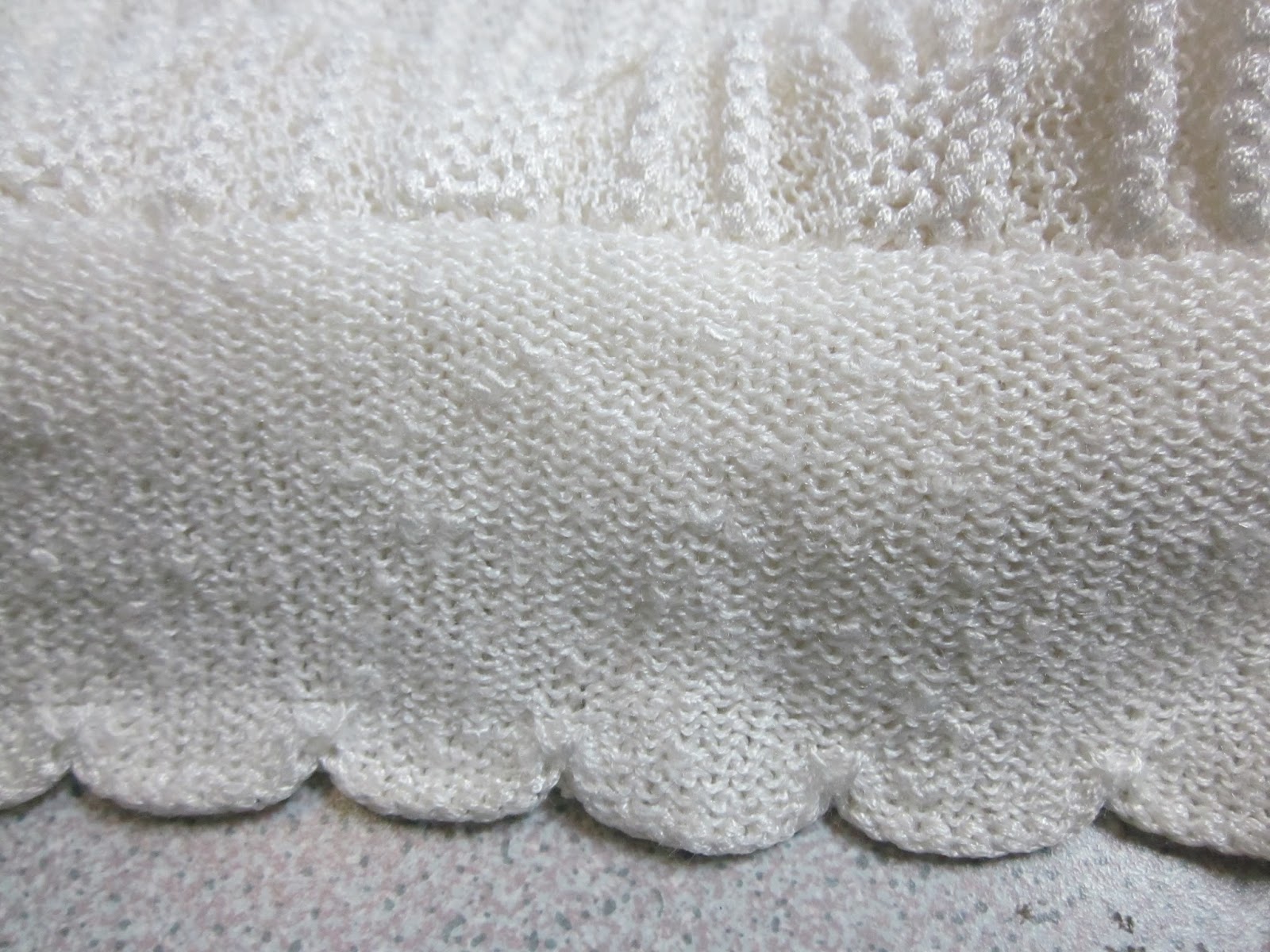
The speaker was Ann Brown, showing hems and edges on her garments, talking through techniques involved and considerations for the weight and hang of them. The main points besides the look and feel of the edging was of course the finishing. A well finished jacket with crisp lines along hem and bands, takes a jacket from the basically crafted, to the professional designer league. Just a few hints and tips from an experienced knitter is enough to make it feel achievable and inspire to try something a bit different than usual ribs.


Ann demonstrated the construction of a scalloped hem by knitting one side of a hem on all sts, then using needles at intervals in holding position knitted tucked rows. Fine ribbon was wrapped then knitted before the second side of tuck rows followed by more straight rows.

 The garter bar was also demonstrated for super fast turning for attaching edges and hems.


The competion


Beginners Class: 
Stephanie was the only entry with a tuck lace scarf that was a long time in the making. Much was learned along the way in understanding placing of needles out of work in order for the punchard and tucking to work in the correct places.


Advanced Class:
1st Phyllis crafted a very interesting textured look with a rib and thread lace top


Joint 2nd
Sue knitted short row shaping in varying strands of Hobby and Silky, a Little Posh Frocks pleated skirt
Valerie created a very differnt looking textured knitted lamp shade


Wednesday, 11 September 2013

July 2013


This month Sandra talked about skirts and brought in patterns, books and skirts she had made. Marcia also brought in skirts she had made so the group had plenty of different methods techniques and styles to see and handle.

Skirts were sideways knitted, ribbed, straight and with godets for shaping.  The textures and yarns used added to the variations and really gave everyone a lot of ideas to try for themselves. Here a some photos of the skirts that were brought in.


Competion
2nd place : Valerie knitted a scarf in tuck lace using glittery yarn with a crochet edging.

1st place: Phyllis knitted a jacket in thread lace. The photo was terrible and will be taken again so just a small sample of the texture is shown.